Augmentation, not alternative

My mother sent me a link to a piece by Jonathan Franzen in the NYT today, with this quote specifically included (italics hers):

This is not to say that love is only about fighting. Love is about bottomless empathy, born out of the heart’s revelation that another person is every bit as real as you are. And this is why love, as I understand it, is always specific. Trying to love all of humanity may be a worthy endeavor, but, in a funny way, it keeps the focus on the self, on the self’s own moral or spiritual well-being. Whereas, to love a specific person, and to identify with his or her struggles and joys as if they were your own, you have to surrender some of your self.

It’s a well-written piece, and the quote my mother cites is lovely, but (unsurprisingly) I completely reject its central thesis which seems to say we can either surf superficially and easily through life with tech or embrace the difficult struggle that is a profound relationship with another person but not do both:

To speak more generally, the ultimate goal of technology, the telos of techne, is to replace a natural world that’s indifferent to our wishes — a world of hurricanes and hardships and breakable hearts, a world of resistance — with a world so responsive to our wishes as to be, effectively, a mere extension of the self.

Wow.  It’s like Stephen Fry’s evil twin has come to town.

No. This is not an either-or world. I relate and laugh and disagree on a daily basis with people who are sharing the same air I do. I also am able to connect joyously and articulately with someone who lives in Singapore – a relationship that would not be possible without technology, as Arvind and I “met” one another on Facebook through our discussions on a mutual friend’s Fb wall (and she is someone I initially “met” online in the pre-Fb era and then was able to see in person years later. Rana and I are good enough friends – not “friends” – that she invited John and me to her wedding).

Additionally, I see arguments and hard discussions all over my friends’ walls. I don’t usually engage in them because Fb is something I reserve for fun, but that says more about me than it does about Fb – lots of people go to church to be soothed, only some go to be challenged. But that doesn’t necessarily say much about church in general: it says something about the people who attend it and the reason they attend it.

I see people all over being perfectly likable – striving to be so, in fact – in their everyday lives with colleagues, acquaintances, and strangers. That doesn’t mean they’re false or hollow or emotionally crippled – it means they’re being polite. And the majority of one’s friends on Fb are actually acquaintances. But what was Fb supposed to call them, anyway? They could have gone with the prolix: “People I know,” the sterile: “Contacts,” or the twee: “Buddies.” “Friends” is both largely accurate and brief. And I’ve found personally that people still recognize the differing levels of friendship and layers of knowledge that exist in human relationships both online and off (I know X more than I know Y, but I know Y’s sense of humor and mine intersect precisely in just such a way…) The technology of Fb doesn’t have to characterize those differences – the people involved do that automatically.  The organic human recognition of the subtleties of specific relationships doesn’t have to be perfectly mirrored or duplicated by the technology.

Sites like Fb and “sexy” new Blackberries and titanium laptops are not intended to replace – they are intended to augment.  And I reject the idea that I have somehow sold my connection to humanity by extending my reach to other human beings.

A disturbing realization

I’m plowing my way through the first in the series of George R.R. Martin’s epic potboilers, A Game of Thrones.  Finally.  Well, I’m finally successfully doing so.  And good grief, but it as actually brought me to a personal epiphany.

I have tried before to read this book and failed miserably.  But John really likes it, and I value his opinion, so I kept trying.  Also, HBO is putting together a series based on the books and it looks really, really good.  Getting it on the Kindle helped (700-page epic doorstop novels are high on my list of things that give equal on the plus and minus sides in entertainment value and repetitive stress injuries).  But for someone like me, this book was sort of like signing up for voluntary sandpapering of second-degree burns or giving Joss Whedon the license to direct the activities of your nearest and dearest for the next few months.  I felt like a petty god was sitting somewhere and saying, “Oh – wait: you like this character?  DEAD,” over and over and over again.

Why so sensitive, Jill?  I don’t know – but I know that I was the person who couldn’t fathom being a divorce attorney because I knew I couldn’t tread the fine line between the empathy required to advocate passionately for my clients and the necessary detachment from their plights to enable strategic thinking.  My emotional balance is wonky that way, even when I read a book.  I read a news report a while ago that talked about people who actually feel pain when they see someone else receive injury – the pain areas in the brain of the person doing the viewing actually light up.  I am pretty sure I am one of those people, and the more I empathize with the person in question, the worse it gets.

This even happens when I read.  Yeah, yeah, yeah – I was one of those kids whose parents said the house would burn around my ears while I read.  About ten years ago I finished The Golden Compass on a Southwest flight in a seat that faced a fellow passenger (a stranger).  When I finished the book and slowly returned to reality this person commented, “I didn’t think you were coming out of that.”  The more I do that deep dive, the more I empathize with death, injury, or loss suffered by the characters I like.  Considering the shelf footage this series takes up, I knew I didn’t have the emotional bandwidth to go through that much bloodshed with my nerves exposed.
So, at long last, I realized that I couldn’t read the book with my usual 100% investment.  I had to view it somewhat dispassionately.  Don’t get attached – everyone’s going to die and probably horribly.  When I made that decision, the pages started ripping by.  And I like the book – I really do.  But I can’t love it the way I have loved other books that were also intricately constructed, intelligent, and well-written.

Here’s the disturbing epiphany.  I have been doing the same thing in life with a lot of 2010.  Not in my personal life, but in my reaction to the constant barrage of bad news.  At some point I flipped from the empathetic to the dispassionate to save my nerves.  And somehow I need to try again to sort out a way to walk that fine line.  Because being dispassionate is not the way I want to face the world.  At least, not entirely.

Edit: here’s my real incentive (to read the books, not to step back from the brink of being a completely dispassionate person-analog) – an HBO series with actors like Nikolaj Coster-Waldau and Peter Dinklage? Yes, please.

Overheard on chat

D: so far our last two immediate topics remind me of the book I just finished
me: well, then.
D: The Guinea Pig Diaries, by A.J. Jacobs
the guy who wrote The Know it All?
me: Day one: “WHEEK, WHEEK!”
Day two: “ooh – PELLETS.”
D: groan
oh please keep going
me: Day three: “Wheeek.  ::snuffle:: WHEEK!”
D: um, sarcasm
me: Day four: “OHAI!  LETTUCE!!  My day is WHEEEEEEEEEK, mofo!!”
D: OHAI LETTUCE
hahahahahahahaaa
me: sometimes the pitch needs a windup…
D: can’t breathe
for laughing
oh that’s good
me: glad you like.
D: oh boy

Blowing one’s trumpet

Bear with me, because there are a few threads I would like to draw together here, and they may come together rather messily.

  1. I’ve had a conversation in a leadership class about the difference between actually getting things done and the activities of self-promoting squeaky wheels who don’t actually contribute.  You know what I’m talking about, I am sure: the Peter Principal jerks who get promoted while those who labor quietly and competently get passed over.
  2. But then there is also the difficulty (sometimes) for management to realize who is doing what and the necessity for people to self-promote in a realistic way that helps the organization and themselves.  If you’re doing good so subtly, is management to be blamed for missing your fingerprints on the good deeds?
  3. The perennial issue of libraries in general being given the shaft during bad economic times no matter how foolish that may be in terms of value for money libraries give in terms of net access, help with finding jobs, and other resources.
  4. The historical tendency* of librarians to want to be recognized for the good they and their institutions do by their quiet competence and effort alone.
  5. This post today from John Scalzi’s blog.

Which brings me to the question – are we thinking (or have we been thinking) about what we do as charity rather than a profession?

* I do realize I am oversimplifying, and I do know that libraries are getting better at promotion.  I do think, however, that they are still behind the curve when it comes to proving the economic utility of what they do.

For those about to hunt the job, I salute you.

Some of my library school cohort are graduating now, and I wanted to share some really hard-earned wisdom from old Auntie Jill.

I had to completely rewrite my resume once.  I have never had writer’s block like this before – I would open my laptop, launch the Word file that contained my resume, stare at it in horror for about 15 seconds, quit the program, close the laptop and go off and do… well, anything.

I knew my experience was good. I knew my resume wasn’t reflective of that, and I did not know how to bridge that gap. As a writer, this particularly irked me. Isn’t this what I’m paid to do? To convince people through my words that something is worth doing? Something like… hiring me, say?

So finally, I sat down with a woman at the expensive outplacement center my former employer was paying for and for two hours she had me read all of the bullet points in my resume one after the other. Did this, wrote that, managed the other thing. And to every point she said, “Which resulted in what?” And the truth slowly dawned that showing results rather than activity was the important thing. And that the results weren’t always obvious to everyone, though they were so screamingly obvious to me that it seemed silly to put them down on the page until I was able to put myself in that other person’s shoes.

Anyone can do stuff.  Prove to the world that the stuff you’re doing makes a difference, and don’t take it for granted that the difference you are making is self-evident.  And congratulations, grads.

Marred for life.

I am using the last of my precious winter break Metro time to do some pleasure reading.  Having sated myself on crime fiction, I got Scott Westerfeld’s Leviathan from the library (which I thoroughly enjoyed – highly recommended to people who like YA, adventure, steampunk, alternate history, or breathing) and ripped through it in about two days.

Waiting in my pile was a book on writing my wise mother handed to me during her last visit, Anne Lamott’s Bird by Bird.  I’m pretty sure she refrained from saying “You’ll love this,” and I think we may have discovered another way around my reflexive filter.  Just hand the thing to me without a deadline for completion.  I’ll happily get to it in my own sweet time.

I have had this book (along with “Writing Down the Bones”) recommended to me at length, and often enthusiastically, which is probably why I hadn’t gotten to either of them before now.*  Predictably, I am loving it.**

As much as I am loving Lamott’s book, one of the charms of getting to read it in the way I did is the scattering of a few tiny post-it notes my mother tucked among the pages.  These notes have cryptic remarks jotted on them which I understand well due to our shared history but might well be written in Urdu for all the sense they would make to a stranger.

Lamott’s book is especially good in one way because it offers you interstitial assignments – they’re not listed as such, but if the reader decided to take them that way, it is very possible to pull literal instructions from every chapter.  In the early going, there is a section on writing about school lunches to break a mental logjam.  Lamott is right when she says that this topic is fertile ground for stories and descriptions.  She herself writes a few humorous paragraphs about the “code” of lunches – what was acceptable and what labeled you as “other” in the eyes of your classmates.  I recognized exactly what she meant, even if the specifics were different when I was growing up.

My lunches, I am afraid, were never up to code.  Mom made lunches that a 40-year-old foodie would swoon over: homemade multigrain bread, real cold cuts (no bologna in my mother’s kitchen), and often bean sprouts.  These were thick, hearty, character-building sandwiches in every sense of the word.  Once, a classmate snatched a tangle of sprouts out of my sandwich, screamed, and flung them away from her as if they were alive.  They stuck to a window high over our heads and remained there for the entire school year, closely resembling the desiccated corpse of a spider.

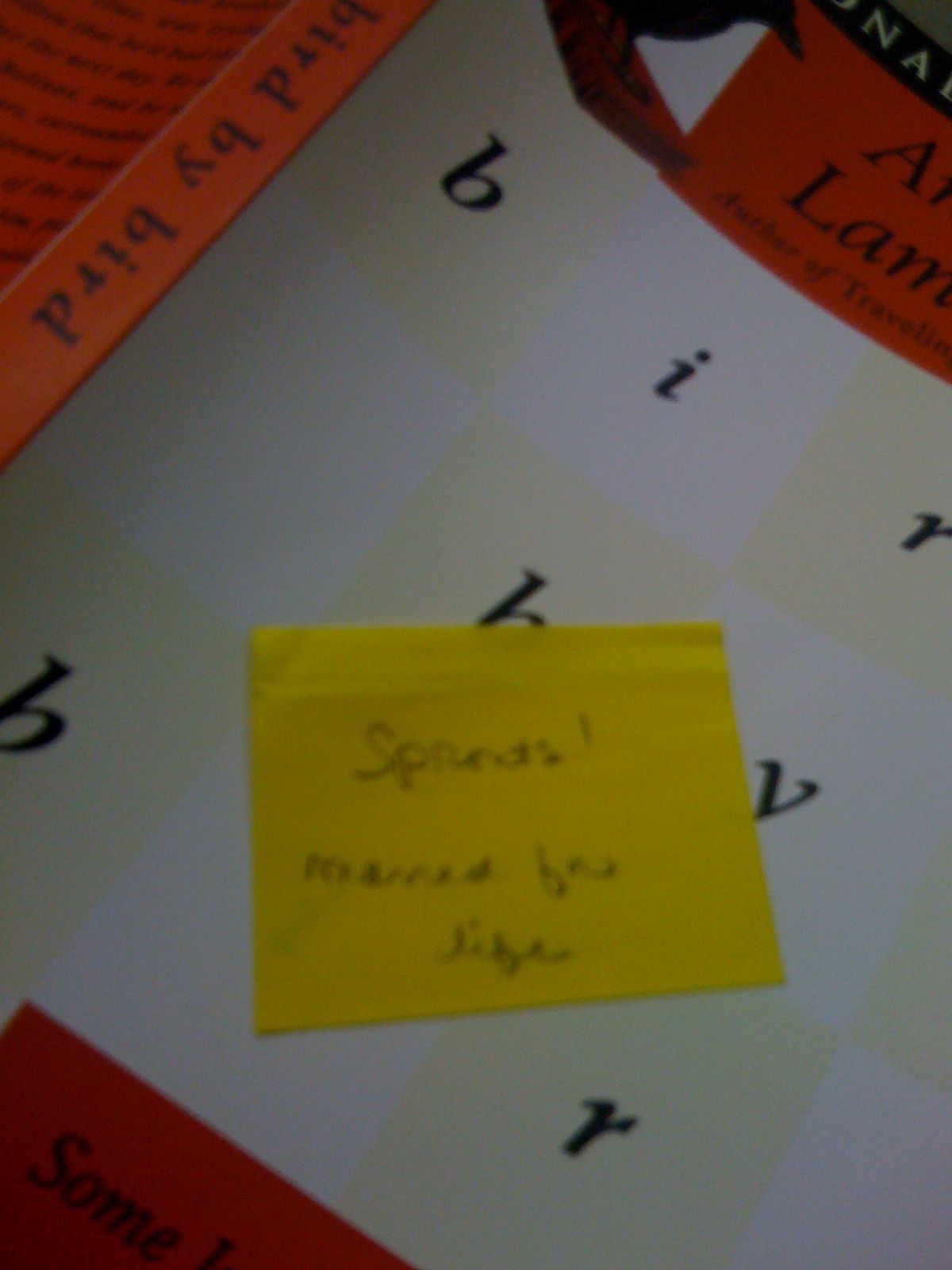
The other thing I remember about my school lunches were the notes.  Mom’s missives, often illustrated with quirky doodles, were like a quick squeeze of the shoulder or a warm smile.  I remember them as full of love and humor and topical information like, “Christmas Tree decorating tonight!” or “5 more days until vacation.”  Mom’s handwriting somehow manages to be both loopy and strong, so finding this note tucked into the pages of Lamott’s book was like something out of a time capsule:

“Sprouts!  Marred for life.”

I laughed like an idiot on the Metro and didn’t care who noticed.

*See above re: “You’ll love this”
**I only said I have a reflexive reaction to over-enthusiastic recommendations.  I didn’t say it was smart.

Is it just me?

Or is there an entire Ph.D. thesis to be wrested from the use of possessives in Season 2 of True Blood?

Eight years ago today

Eight years ago today, I was sitting in an office in Kendall Square, Cambridge, Massachusetts, planning for a conference I was set to attend the next day in Washington, DC.

Someone said something about a plane hitting a building in New York.  My first thought was, “not likely,” and my second was, “if it did happen, it had to have been a small aircraft.”

Shows what I know.

I don’t remember how it was that the urgency of that morning swept through our open-plan office, or why I ended up standing in front of the tiny television in our break room, staring at a commercial jet jammed into one of the Twin Towers, and then – the other.  I do remember the receptionist asking me to pick up the phone: a friend, knowing I lived in Boston and traveled a great deal, had called me from Louisiana to make sure I was safe.  I numbly told her I was.

A few hours later, we were told we could go home, encouraged to hug our families.  I fled out into the incongruous fall sunshine, darted towards the apartment that was only recently “home” to me.

My mother came over.  I know we hugged.  We must have cried.

I used to work for a company that had its headquarters across the street from those tall, tall towers.  I had left on good terms a few months prior, and my boss and colleagues treated me to champagne at Windows on the World.  That spring day, the fog was thick outside the windows and the famous view replaced by a vista of flat gray.  Inside the bar, white uniforms had moved among dark business suits.  Fleet Week.   We had laughed.  Only in New York.

I spent a lot of time that day trying to track down former colleagues, friends.  One had been driving in to work, saw the first plane.  She had called human resources from her car, told HR to get everyone out of the building as the unthinkable unrolled in front of her.  When I spoke to her, her voice was a thread.  My former boss, the woman who had treated me to champagne that spring day, had walked 50 flights of stairs to get to ground level.  I don’t know how she actually got home.  Those 50 flights were only the beginning.

John drove up, and we sat on the front steps, drinking and talking.  Confusion and helplessness seemed to be all we were capable of.  The luxury of the everyday was going to be a while coming.

Hitting the wall

John asked me the other day if I had given up blogging completely.  I don’t think he was kidding, either.

The short answer is, “no.”  The longer answer has something to do with the combined effect of summer, school, and a full-time job.  I haven’t felt much like doing a lot of the things I usually enjoy doing: writing, running, and knitting are all on that list these days.

In the past, I might have freaked out, decided that I must make myself do these things I enjoy doing — else, who am I?  Enter identity crisis, then insert frenzied period of making a job out of things I enjoy, which is pretty much a one-way ticket to aversionville.

It only took me a couple of decades to figure out how utterly insane this is.

So, my new method of dealing with that feeling is to use the old “if you love something let it go” philosophy.  I have a pretty solid notion that these things I do truly love to do will return to me in their own time without my insisting that they Come. Back. Right. Now.  (A negotiation tactic that is only slightly less effective on one’s own desires than it is on our dog — which is to say, on a scale from “not very” to “not at all”).

In the interim, apologies for the light posting.

What I meant by that.

A few days ago, I posted this, which I admit was rather cryptic:

Hey!  Do you dislike some Thing?  Has someone else expressed an appreciation for that Thing?  Well, by all means – the most appropriate thing is to crap all over that Thing!  Otherwise, how else would anyone know you’re too cool for that Thing!  Now go – be scathing!  Extra points for using a really limited data set to express how little you know about that Thing!

What did I mean by that?  Well, I have been thinking lately about how much harder it can be to enthuse than to sneer.  Sneering somehow has a patina of respectability, whereas enthusiasm is often considered a bit twee.  If you scoff, the implication is your tastes are higher and purer than those who love (or even appreciate) the thing you scoff at.  Conversely, if you enthuse, you are shallow.

It takes a certain amount of bravery, I think, to simply say that you like something.  And the word “simply” is there for a reason.  It takes far less bravery to attempt to defuse the potential scorn of your audience by saying, “Well it’s not highbrow, but…” or “I know you may not like it, but…” or any other apologetic phrases that preemptively excuse your egregious cultural lapse.  

This is not to say that I believe that everyone must appreciate everything.  But how hard is it to say, “Oh – yeah.  I tried that and it wasn’t my thing,” or even, “Well, I heard about it and it didn’t sound interesting to me.”  Instead, all too often I hear people expending huge amounts of energy on vast verbal rampages of withering scorn that not only label the thing they are discussing as utter and complete trash, but state or imply that anyone who does like that thing has the taste and discrimination of a toddler.  It is not enough to dislike it — you must make sure that everyone else either dislikes it too, or is shamed for their preference.

Worse yet, if you intimately know the thing that the speaker is ripping to shreds, you may detect that they are only familiar with a tiny piece of the entire work.  The first chapter of the novel is taken as a stand-in for the whole or the one movie is emblematic of the director’s entire body of work.  It makes sense that the person who didn’t appreciate the work didn’t go on to find out whether or not it grows on them or if their single experience was an anomaly — who hasn’t given up on something they’re not enjoying?  But the assumption that everything that flows from that source must be identical to the part the speaker didn’t like is absurd.

When you agree with someone that the thing they decry is pretty shoddy and the speaker has a certain amount of verbal facility and a cutting sense of humor, these rants can admittedly be entertaining.  But it strikes me as an adolescent kind of entertainment: ripping down rather than building up.  And if those in agreement start piling on, doing their own share of the ripping, then the results can be downright adolescent in their ugliness.

Let me be clear and say also that I am not saying that criticism itself is bad.  I don’t believe that at all.  But the particular type of criticism that doesn’t just say, “I don’t like this,” or “I think this was badly done and here is why,” or “This story has been told before and done much better,” but must go on to ravage the entire landscape and salt the earth by saying something akin to, “This is utter crap and anyone who likes it must be intellectually and culturally deficient,” well, that for me is a bridge too far.  What does the speaker mean to achieve by such a statement?  Will the people who are the objects of his scorn suddenly say, “Oh – you are so right.  I do have terrible taste.  Please take me under your wing and show me the right way to think and feel.”  I’m thinking the answer to that one is no.  So what is left for the speaker?  The satisfaction that no stone was left unturned in the pursuit of expressing their loathing?  

I know I’ve done my share of ripping.  You have to be pretty saintly to be immune to the lure of looking clever and sharp, especially before a certain audience.  But henceforth I’m going to put my energies towards either appreciation or constructive criticism, and I will try to make sure that my expressions steer clear of the sort that either say or imply that I believe that the appreciation of something I dislike represents some sort of moral failing.  The scornful may keep their scorn with my compliments.  I like what I like.