



Archives for January 2010

Marred for life.

I am using the last of my precious winter break Metro time to do some pleasure reading.  Having sated myself on crime fiction, I got Scott Westerfeld’s Leviathan from the library (which I thoroughly enjoyed – highly recommended to people who like YA, adventure, steampunk, alternate history, or breathing) and ripped through it in about two days.

Waiting in my pile was a book on writing my wise mother handed to me during her last visit, Anne Lamott’s Bird by Bird.  I’m pretty sure she refrained from saying “You’ll love this,” and I think we may have discovered another way around my reflexive filter.  Just hand the thing to me without a deadline for completion.  I’ll happily get to it in my own sweet time.

I have had this book (along with “Writing Down the Bones”) recommended to me at length, and often enthusiastically, which is probably why I hadn’t gotten to either of them before now.*  Predictably, I am loving it.**

As much as I am loving Lamott’s book, one of the charms of getting to read it in the way I did is the scattering of a few tiny post-it notes my mother tucked among the pages.  These notes have cryptic remarks jotted on them which I understand well due to our shared history but might well be written in Urdu for all the sense they would make to a stranger.

Lamott’s book is especially good in one way because it offers you interstitial assignments – they’re not listed as such, but if the reader decided to take them that way, it is very possible to pull literal instructions from every chapter.  In the early going, there is a section on writing about school lunches to break a mental logjam.  Lamott is right when she says that this topic is fertile ground for stories and descriptions.  She herself writes a few humorous paragraphs about the “code” of lunches – what was acceptable and what labeled you as “other” in the eyes of your classmates.  I recognized exactly what she meant, even if the specifics were different when I was growing up.

My lunches, I am afraid, were never up to code.  Mom made lunches that a 40-year-old foodie would swoon over: homemade multigrain bread, real cold cuts (no bologna in my mother’s kitchen), and often bean sprouts.  These were thick, hearty, character-building sandwiches in every sense of the word.  Once, a classmate snatched a tangle of sprouts out of my sandwich, screamed, and flung them away from her as if they were alive.  They stuck to a window high over our heads and remained there for the entire school year, closely resembling the desiccated corpse of a spider.

The other thing I remember about my school lunches were the notes.  Mom’s missives, often illustrated with quirky doodles, were like a quick squeeze of the shoulder or a warm smile.  I remember them as full of love and humor and topical information like, “Christmas Tree decorating tonight!” or “5 more days until vacation.”  Mom’s handwriting somehow manages to be both loopy and strong, so finding this note tucked into the pages of Lamott’s book was like something out of a time capsule:
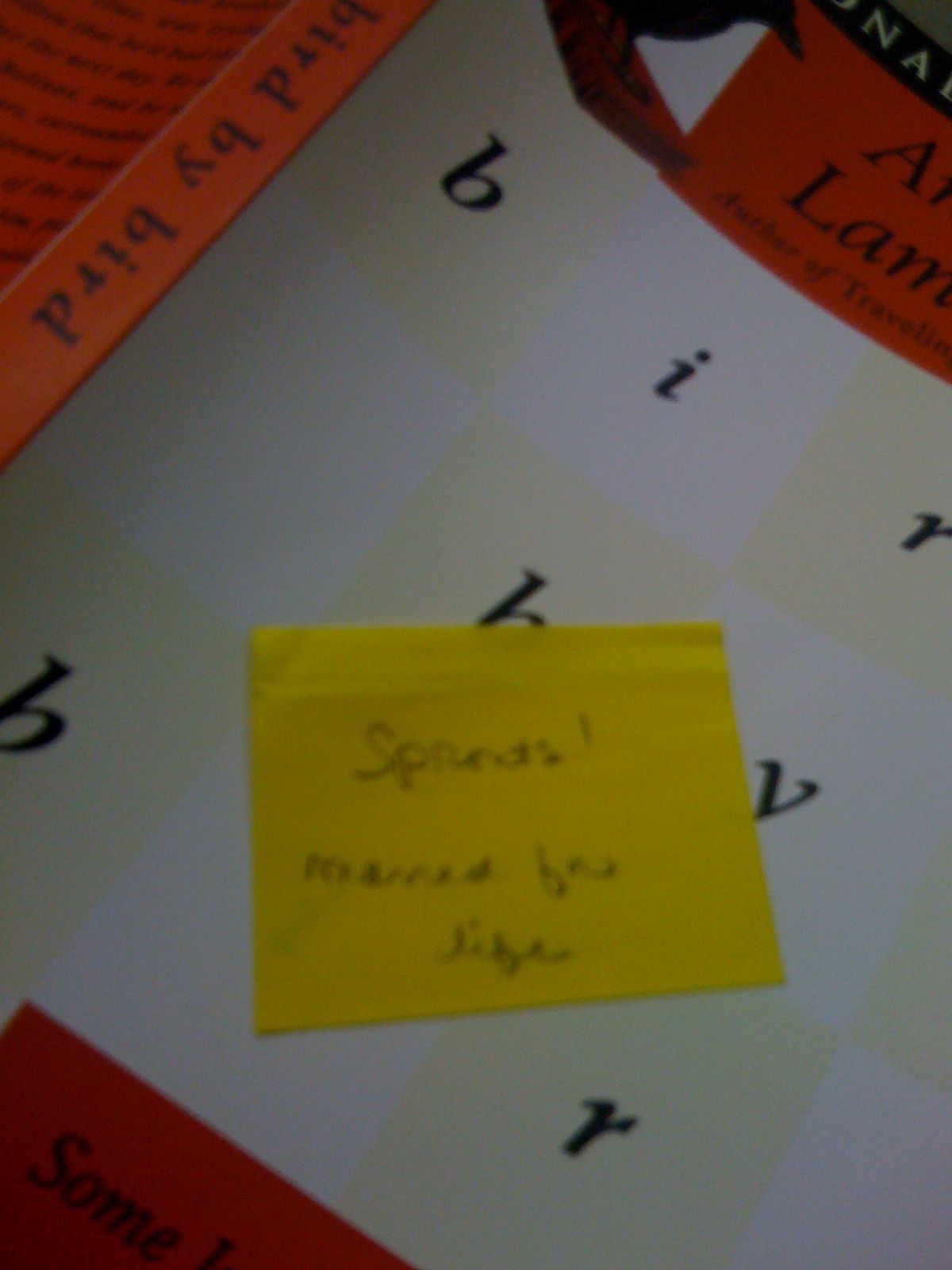
“Sprouts!  Marred for life.”

I laughed like an idiot on the Metro and didn’t care who noticed.

*See above re: “You’ll love this”
**I only said I have a reflexive reaction to over-enthusiastic recommendations.  I didn’t say it was smart.

Similar to yesterday’s accent rant…

Yesterday, I went on a bit about using regionally-appropriate language, especially if the character in question is of a different nationality from the actor playing said character.  For my next unnatural act, I am going to go on a bit about regional pronunciation.

I had thought this rant was already written, but if so, I can’t find it.  I know I have had the conversation plenty of times.

Ever watched something set in or near your hometown?  Did the characters sound like they were locals?  Why or why not (show your work).

My example is this: back in 2000, the USA channel aired a made-for-TV movie of Robert Parker’s “Thin Air.” The bulk of this movie is set in the Massachusetts town of Haverhill.  There are two things I remember about this movie:

  1. I don’t buy Joe Mantegna as Spenser, and
  2. Nobody in the entire movie pronounced the town name like a Massachusetts native would.

All my life, the name “Haverhill” has been pronounced “HAY-vrill” (well, the i is more of a schwa, but I can’t be bothered to find the encoding for schwa – I’d rather take the time and effort to type about how I can’t be bothered to do a simple Google search).  But all the characters in the movie (including alleged natives of that town) called it “HAVE-ur-hill.”  Even the people trying for a Massachusetts accent.

Now, I’ve done it.  All of my New England readers have run screaming from the room.

So, instead of just watching the movie (or turning it off, which would have been a better option), I kept waiting for someone – ANYONE to pronounce the town name like someone who had spent even a week in Massachusetts would*.  And when they didn’t (not a single person did), I kept flinching and putting my tongue between my teeth the way you do when someone skrees a chalkboard.

Please, oh people who spend vast amounts of money to make television entertainment, get’chiself some real local cullah if yer gonna make ye’self some wicked pissah entuhtainment.

*Well, anyone who was trying to impersonate a native.  My Indiana-born-and-bred grandmother still calls Worcester “WUR-ches-ter,” when EVERYONE knows it’s “WUS-tah.”**

**I think that’s the key to the Mass accent – fewer syllables.

You’re not fooling anyone, you know.

A small note to people who make movies and television with actors not using their native accents:

It really doesn’t help when the non-native character’s dialogue is decidedly… native.

An example?  Sure, I can give you an example.   For unknown reasons, BBC America has decided to air the television show “Demons ” for us Yanks.  Aside from making a sane person wonder why they produced a show which is essentially “A British Buffy in London” (you can see why I don’t write titles for television), they decided that the teen-with-a-destiny’s mentor had to be American.  And for that American, they cast the toweringly magnificent blusterer, Philip Glenister.

So, okay.  Glenister is apparently working on his American accent.  Why?  Maybe he looked at Hugh Laurie’s career and said, “Well that bloke seems to be doing pretty well for himself,” and signed on.  Maybe he wants to get into Hollywood movies.  Maybe… who cares.  At any rate, he wanted to stretch his skills.  All fine so far.

Except, he seems to be having trouble with it.  And again, I don’t really care all that much.  Accents can be tough, and I would imagine doing an American accent in England is probably doubly tough.  It is probably easier to do an accent when you are filming in that country: after all, you can just turn to upwards of 90% of the crew or walk down the street on your lunch break and hear the accent you’re going for in that case.

But here is where my patience breaks down.  If you are a British* writer, please consult an American about the American character’s dialogue.  If you don’t have an American friend, find one.  Because the final nail in the coffin of an actor’s attempt at an accent is to hear them say something that 99.9% of the people in that country just wouldn’t say.  When Philip Glenister, struggling manfully with a midwestern-neutral American accent** says something about the main character’s dad dying in a “car smash,” that’s where I just stop giving the benefit of the doubt.  Because we say “car crash” or “car wreck.”

Unless you’re a pretentious git*** like me who has spent a fair bit of time in the UK, read a lot of British literature,  and watches more British media than is probably good for her, then the following sentences wouldn’t come out of an American’s mouth unless it was put there by a writer:

  • So Jess, I says, get your skates on or we’re going to miss the queue for the motor-coach.
  • Her problem is she would always take the lift in an emergency, when the notices all say use the stairs.
  • The Skoda wasn’t half ruined in that lorry smash, but you don’t hear me whingeing about it.
  • That bloke’s bird is a silly cow.
  • Eat your tea.

I could go on.  But I won’t.

*Or an American writer writing a British character, I am sure – but I am not British, so I don’t get to do that rant.

**Hint: pick a geography.  Make the character a New Yorker or a Bostonian or Texan… ANYTHING but the neutral news-anchor “nothing” accent, because those accents will give you something to anchor the accent to.  Dipthongs are your FRIEND, Phil.

***We don’t say this either.